
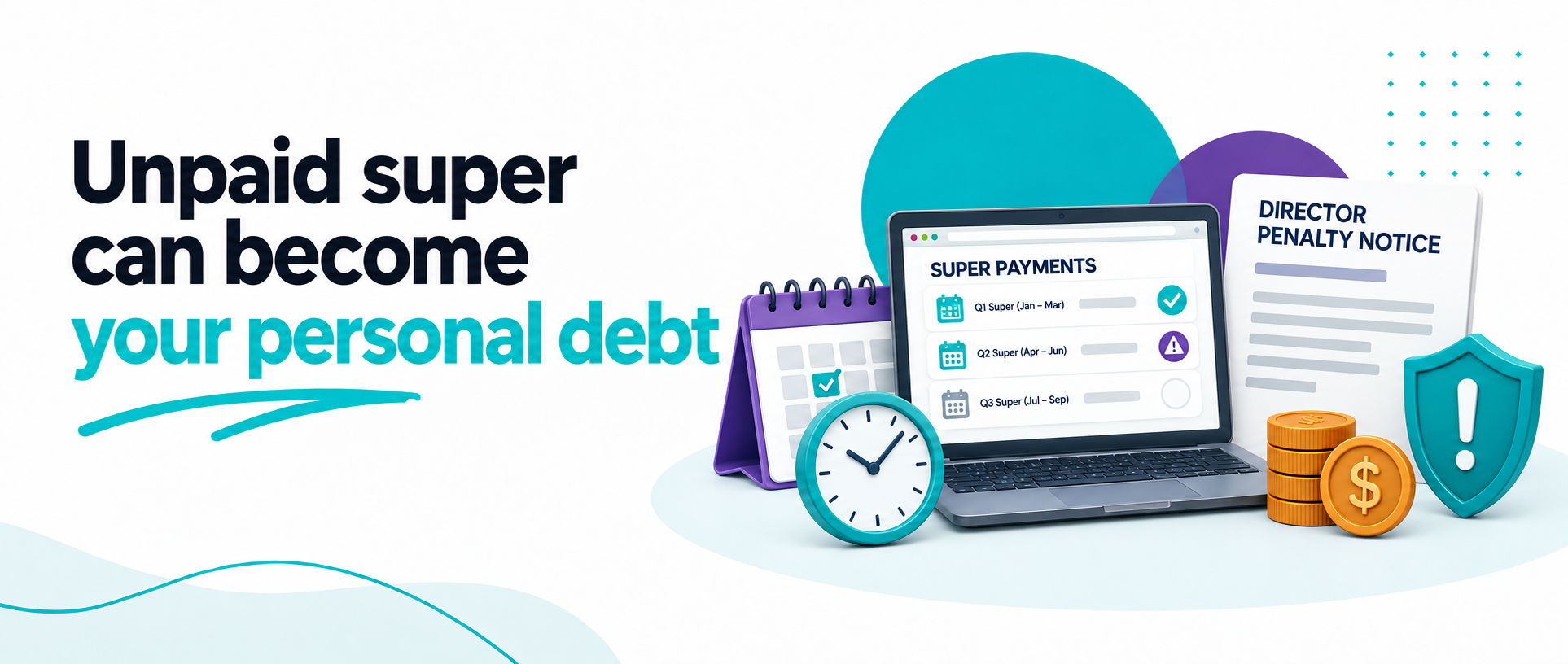
Payday super started on 1 July 2026, so super now has to reach your employees’ funds within seven business days of each payday. A Federal Court decision handed down in July is a reminder of where unpaid super ends up when a business runs into trouble.
What happened
A civil construction company fell behind on super across three quarters while it was under financial pressure. It did not lodge super guarantee statements for those quarters, so the ATO issued default assessments for the super guarantee charge. The company went into liquidation in late 2017 and the ATO then issued director penalty notices to the three brothers who ran it, making each of them personally liable. The Federal Court dismissed their challenge.
The directors argued they had taken all reasonable steps to keep the company compliant. They pointed to consultants engaged to help refinance the business, extra funding raised so wages and super could be paid, along with proceeds from asset sales. The Court found those steps were directed at keeping the business trading rather than at the super guarantee charge itself, so the defence did not get up.
A detail worth knowing
For one of those quarters the company did pay. The money left its bank account on the due date, but the super fund did not receive it until three days later. A shortfall arose for that quarter anyway.
That was not the reason the directors ended up personally liable. It is worth knowing because it shows how strict the timing rule is. Super counts when the fund receives it, not when you send it. There is no allowance for a payment that left on time but was processed slowly.
Why this matters more now
Under the old rules you had 28 days after the end of a quarter to get super paid, which gave you a buffer for processing delays. That buffer has gone. The seven business day clock now runs from every payday. Because you report super through Single Touch Payroll each pay run, the ATO can see a late payment almost straight away.
The most common cause of a late contribution is not forgetting to pay. It is processing time. If your clearing house takes three or four business days to pass the money on and you pay near the end of the window, you can be late without doing anything wrong. Rejected payments have the same effect. The clock keeps running while you sort them out.
Key takeaway
Pay on payday rather than at the deadline, allowing for any clearing house delays. Check each pay run for rejected contributions and get the corrected payment to the fund inside the same seven business days, because a rejected contribution counts the same as one that was never made.
If cash is tight and you think you are going to be late, the reporting has changed. There is no longer a super guarantee charge statement to lodge. You can instead lodge a voluntary disclosure statement, which has to be in before the ATO issues an assessment for that payday. Lodging it within 30 days of the payday can cut the administrative uplift that sits on top of the shortfall, potentially to nil if you have not had an ATO assessment in the past two years. Once the ATO assesses, that option is gone.
Talk to your accountant as soon as you know there is a problem, because there is far more that can be done before a director penalty notice arrives than after.
Get Cashed Up
Liability limited by a Scheme approved under Professional Standards Legislation.
Select your desired option below to share a direct link to this page.
Your friends or family will thank you later.