

On 1 October 2026, the ATO announced it would stop accepting credit card payments after 30 November 2026. Following discussions with the government and extra transitional funding, that date has now moved to 30 June 2027, giving you more time to review your ATO payment options.
What this means for you
If you pay your BAS, PAYG instalments or tax bills by credit card, nothing changes for now. You can keep paying the ATO by credit card until 30 June 2027.
The same applies to ATO payment plans linked to a credit card. After 30 June 2027 those payments will fail, so you’ll need to switch to another payment method before then to keep your plan on track.
After 30 June 2027
You’ll still be able to pay the ATO by credit card through a third-party payment provider. These providers charge fees and can take longer to process payments, so check the costs and timing before you sign up. The ATO also recommends checking that any provider is legitimate before you share your details or make a payment, as scammers are known to target tax payments.
Your other ATO payment options, such as BPAY and direct debit from a bank account, remain available. The full list is at ato.gov.au/howtopay.
Key takeaway
There is nothing to change before 30 June 2027 but use the extra time to plan. If you rely on a credit card to manage cash flow around tax payments, talk to your accountant about how you’ll handle those payments from July 2027.
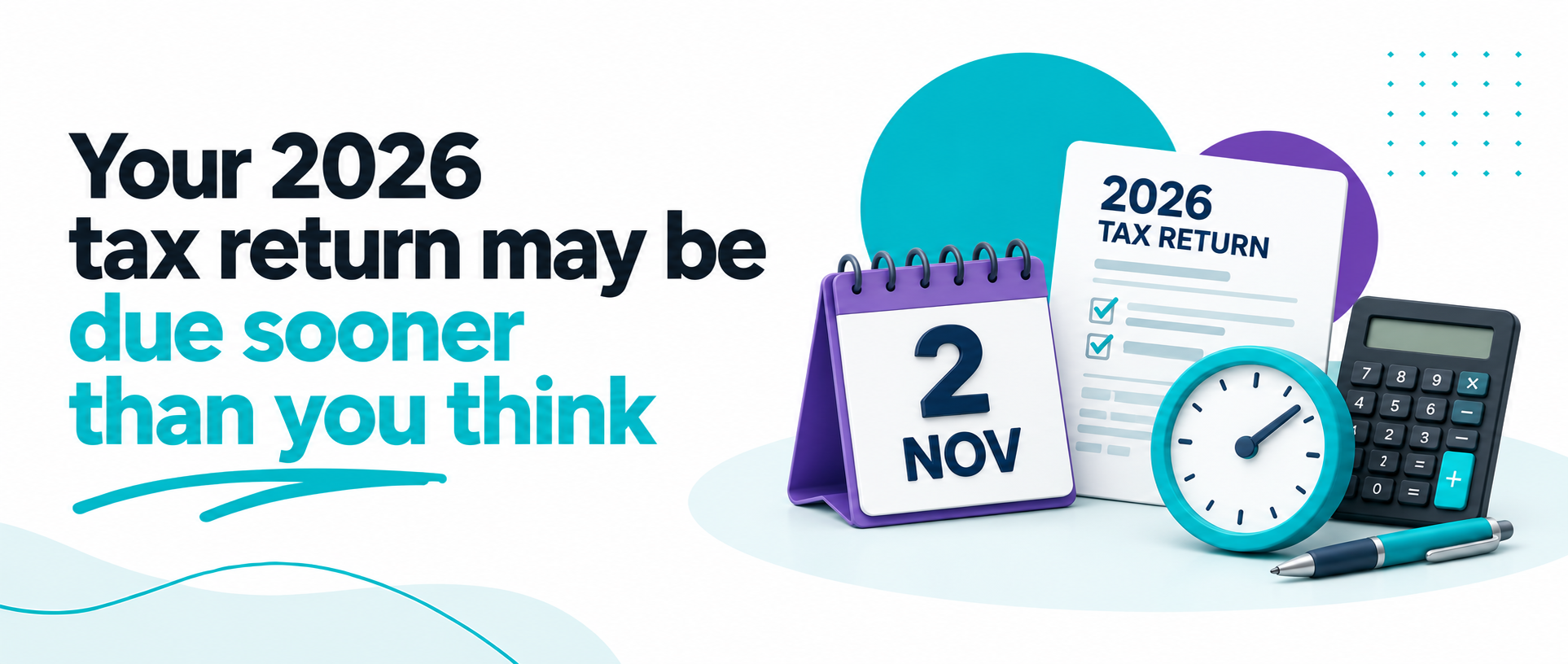
Most people who use an accountant assume their 2026 tax return isn’t due until next year. For some, it’s due at the end of this month. Your 2026 tax return due date depends on who lodges your return and whether your earlier returns are up to date.
Self-lodged returns are due 31 October. This year that falls on a Saturday, so you have until Monday 2 November.
Ask your accountant when your return is due. Most people who lodge through a registered tax agent get until 15 May 2027 under the ATO’s lodgement program. That later date isn’t automatic, though. You need to be on your accountant’s client list by 31 October to get it.
Some people get an earlier date. If your latest return had a tax liability of $20,000 or more, your 2026 return is due 31 March 2027.
If any of your earlier tax returns were still overdue at 30 June 2026, your 2026 return is due 31 October, even if an accountant lodges it for you. It doesn’t matter which year the overdue return is for.
You can get the later date back by lodging every overdue return by 31 October. If that isn’t possible, your accountant may be able to ask the ATO for more time but it isn’t guaranteed. Overdue returns can also attract penalties when they are lodged, so the sooner the better.
Check your due date now. If you have an accountant, ask whether your return is on the later date. If you have an older return outstanding, get it sorted before 31 October.
Not sure which date applies to you? Talk to our team and we’ll check your lodgement status.

Treasury has released draft legislation for several 2026-27 Budget measures. The one most likely to affect you is the change to the fringe benefits tax (FBT) exemption for electric cars. It is still draft law and the detail could change, but the direction is clear.
What’s changing
Right now, an eligible electric car provided through your business or a novated lease is fully exempt from FBT if its value is under the luxury car tax threshold for fuel-efficient vehicles. That threshold is $91,661 for 2026-27.
The draft law phases this out based on when the arrangement is committed to:
What it means in dollars
Take an $80,000 EV used privately all year under an arrangement committed to from 1 April 2027. Under the current rules there is no FBT. Under the new rules FBT would be about $11,700 a year. The same car in petrol or diesel would attract about $15,600 a year in FBT.
What does this mean for you?
If you are thinking about an EV through your business or a novated lease, the price of the car and the timing now matter. Cars above $75,000 lose the full exemption for arrangements committed to from 1 April 2027. Cars at $75,000 or less have until 1 April 2029. Existing arrangements are not affected. If your current lease is coming to an end, check with your accountant before you renew.
Also in the draft laws: monthly PAYG instalments
From 1 July 2027 you will be able to choose to report and pay PAYG instalments monthly instead of quarterly, which we covered in August. The draft law also confirms that taxpayers with a history of not meeting their obligations will be required to go monthly. That is one more reason to keep your lodgements and payments up to date.
Key takeaway
None of this is law yet, so there is nothing to action today. If you are planning an EV purchase or novated lease in the next 18 months, speak to your accountant before you commit so the timing works in your favour.
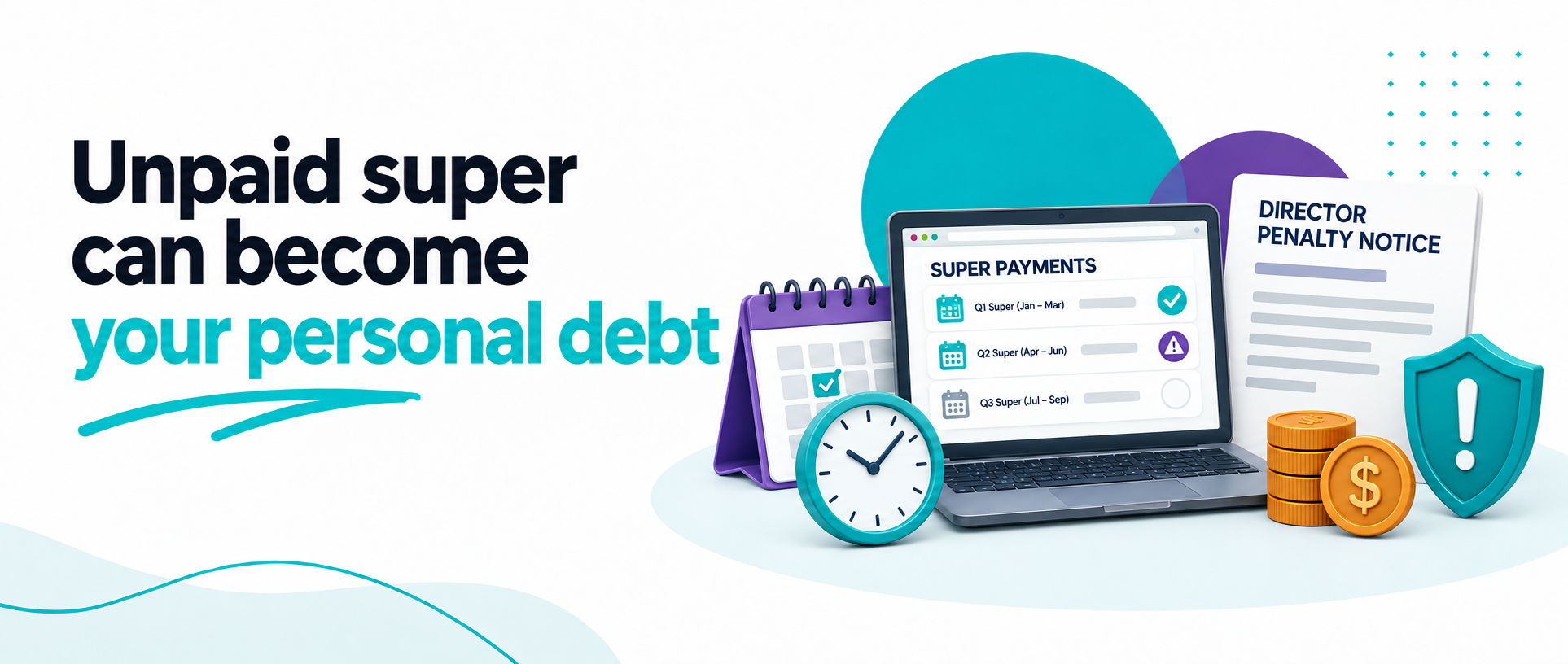
Payday super started on 1 July 2026, so super now has to reach your employees’ funds within seven business days of each payday. A Federal Court decision handed down in July is a reminder of where unpaid super ends up when a business runs into trouble.
What happened
A civil construction company fell behind on super across three quarters while it was under financial pressure. It did not lodge super guarantee statements for those quarters, so the ATO issued default assessments for the super guarantee charge. The company went into liquidation in late 2017 and the ATO then issued director penalty notices to the three brothers who ran it, making each of them personally liable. The Federal Court dismissed their challenge.
The directors argued they had taken all reasonable steps to keep the company compliant. They pointed to consultants engaged to help refinance the business, extra funding raised so wages and super could be paid, along with proceeds from asset sales. The Court found those steps were directed at keeping the business trading rather than at the super guarantee charge itself, so the defence did not get up.
A detail worth knowing
For one of those quarters the company did pay. The money left its bank account on the due date, but the super fund did not receive it until three days later. A shortfall arose for that quarter anyway.
That was not the reason the directors ended up personally liable. It is worth knowing because it shows how strict the timing rule is. Super counts when the fund receives it, not when you send it. There is no allowance for a payment that left on time but was processed slowly.
Why this matters more now
Under the old rules you had 28 days after the end of a quarter to get super paid, which gave you a buffer for processing delays. That buffer has gone. The seven business day clock now runs from every payday. Because you report super through Single Touch Payroll each pay run, the ATO can see a late payment almost straight away.
The most common cause of a late contribution is not forgetting to pay. It is processing time. If your clearing house takes three or four business days to pass the money on and you pay near the end of the window, you can be late without doing anything wrong. Rejected payments have the same effect. The clock keeps running while you sort them out.
Key takeaway
Pay on payday rather than at the deadline, allowing for any clearing house delays. Check each pay run for rejected contributions and get the corrected payment to the fund inside the same seven business days, because a rejected contribution counts the same as one that was never made.
If cash is tight and you think you are going to be late, the reporting has changed. There is no longer a super guarantee charge statement to lodge. You can instead lodge a voluntary disclosure statement, which has to be in before the ATO issues an assessment for that payday. Lodging it within 30 days of the payday can cut the administrative uplift that sits on top of the shortfall, potentially to nil if you have not had an ATO assessment in the past two years. Once the ATO assesses, that option is gone.
Talk to your accountant as soon as you know there is a problem, because there is far more that can be done before a director penalty notice arrives than after.

The same legislation brings back loss carry back for companies, this time as a permanent feature rather than a temporary measure.
What it does
Normally a company that makes a tax loss carries it forward and waits for future profits to use it. Loss carry back lets the company look backwards instead, applying the loss against tax it has already paid and receiving a refundable tax offset.
If your company makes a tax loss in an income year starting on or after 1 July 2026, so the 2026-27 year onwards, it can carry that loss back against tax paid in either or both of the two previous years.
How much you actually get back
Three things set the size of the refund. You get whichever is smallest.
The loss itself. The offset is broadly the loss multiplied by the company tax rate for the loss year. A $200,000 loss at 25% is worth $50,000, however profitable the earlier years were.
The earlier years. The company needs to have had an income tax liability in one or both of the two previous years. The loss is carried back against the taxable income of those years, so if there was no tax liability there is nothing to carry it back against.
The franking account. The offset is capped at the company’s franking account balance at the end of the loss year. Tax that has already been passed out to shareholders as franked dividends cannot be claimed back a second time.
Putting those together, say the company paid $100,000 of tax over the two earlier years then declared franked dividends that used $70,000 of those credits. That leaves $30,000 in the franking account. A $200,000 loss would otherwise support a $50,000 refund, but $30,000 is the ceiling. The unused part of the loss is still available to carry forward against future profits in the usual way.
The franking account is the one that tends to catch people out, because it turns on dividend decisions made in earlier years. It is worth thinking about before the dividends go out rather than after.
Two other points. The rules apply to revenue losses only, not capital losses. They also only apply to companies, so losses in a trust or in your own name are not affected. There are also conditions around having your returns lodged and formally choosing to claim the offset in the loss year, which we would work through with you at the time.
Key takeaway
Nothing is claimable yet, because the first eligible loss year is 2026-27. What matters now is knowing the option exists. If your company has had a couple of profitable years then hits a weaker one, discuss options with your accountant during tax planning, because loss carry back can turn that loss into cash now rather than a deduction you use years down the track.
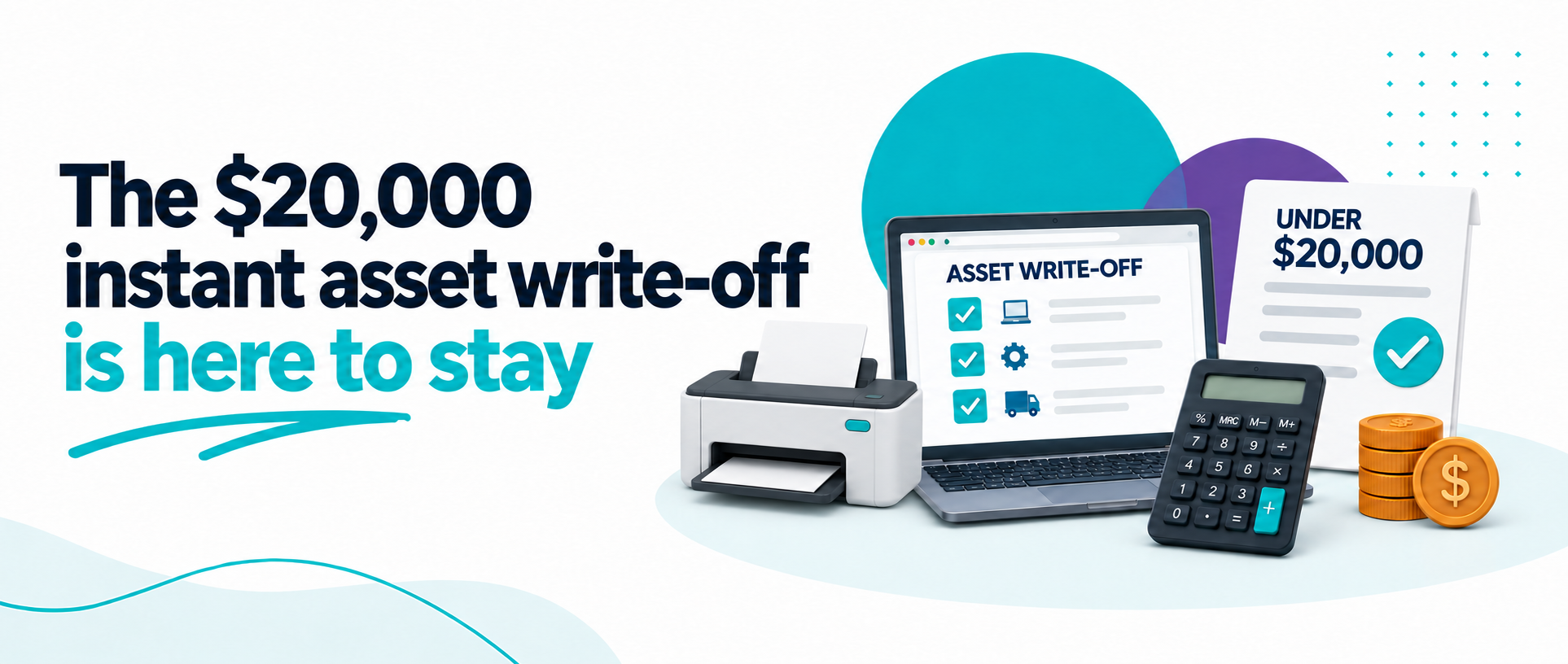
For the past couple of years, the $20K instant asset write-off has been extended twelve months at a time. Under the law as it stood, the threshold was going to drop back to $1,000 from 1 July 2026. Legislation that passed Parliament recently has now locked it in at $20,000 permanently.
How it works
If your business has aggregated turnover under $10 million and uses the simplified depreciation rules, you can immediately deduct the business portion of an eligible asset costing less than $20,000, provided it is first used or installed ready for use from 1 July 2026.
The threshold applies per asset, so several qualifying purchases can each be written off in full. Anything costing $20,000 or more goes into the small business pool and is depreciated at 15% in the first year then 30% each year after that.
What actually changes for you
The rules themselves are the same ones you have been using. What changes is the certainty. The annual guessing game about whether the threshold would be extended again is over, so you can buy equipment when the business needs it rather than rushing a decision before 30 June.
That said, the deduction is still only worth having if the asset is needed or helps you generate revenue. Spending $18,000 to save tax at 25% is not a good outcome on its own.
Key takeaway
If you have been holding off on equipment because you were not sure the write-off would still be around, that uncertainty is gone. Have a chat to your accountant first before you commit to a large purchase so they can check the asset qualifies, the impact on your business cashflow and also put you in contact with a reliable finance broker (if needed).
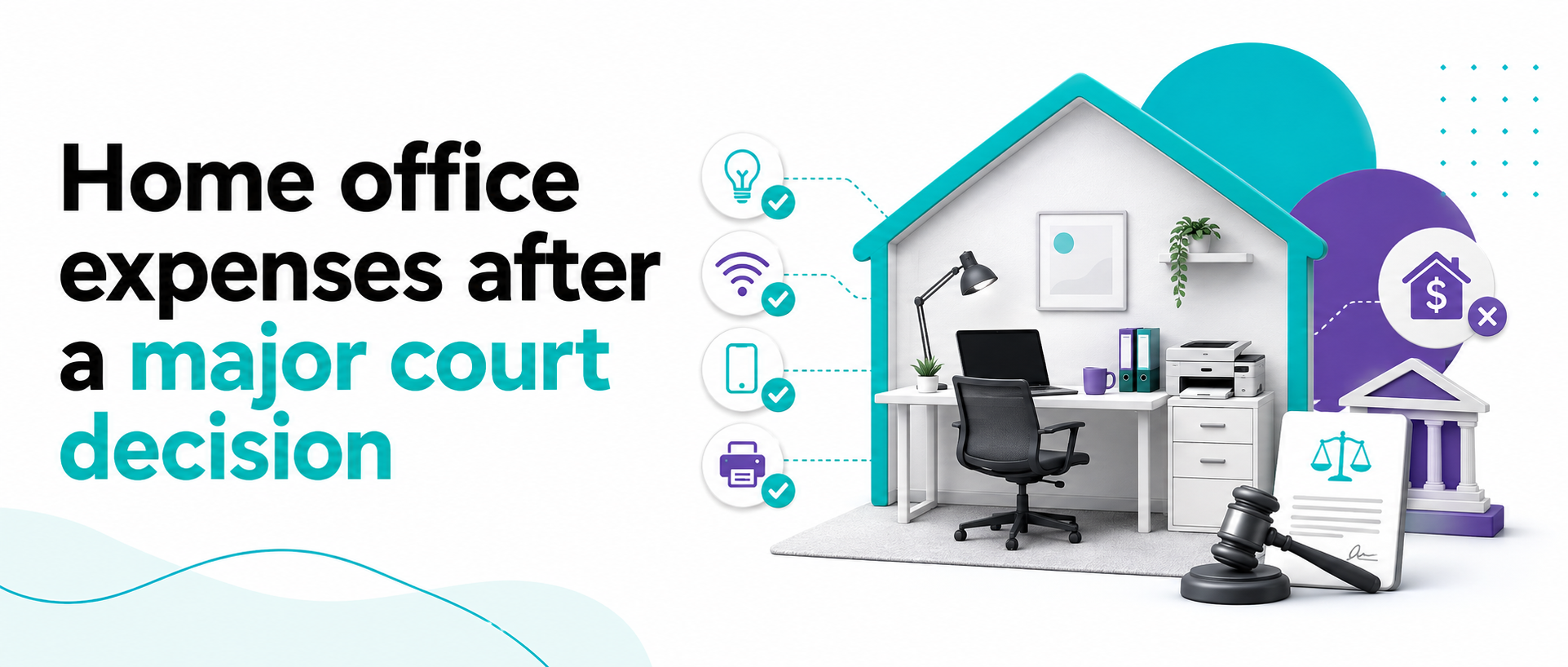
A Full Federal Court decision handed down earlier this year has reinforced a distinction that trips up a lot of employees and business owners working from home, the difference between running expenses and occupancy expenses.
The two types of home office expense
Running expenses cover the additional cost of working from home, electricity, internet, phone use, depreciation of office equipment. These are generally deductible for employees and business owners alike, either using the fixed rate method (70 cents per hour) or the actual cost method. Both methods require a record of the actual hours worked from home for the entire year, not an estimate or a sample period.
Occupancy expenses cover the cost of the property itself, rent, mortgage interest, council rates, home insurance. These have always been much harder for employees to claim.
What the court decided
The case involved an employee who was required by his employer and by COVID-19 restrictions to work from a dedicated room in his rented apartment for the majority of his role. He claimed a portion of his rent as a deduction. The Full Federal Court ruled against him, even though the room was used exclusively for work and he had no real choice about where he worked.
The court’s reasoning matters more than the facts. Rent is private or domestic in nature because of what it is, payment for accommodation, not because of how the space is used. Being compelled to work from home, using a room exclusively for work or having no alternative workplace does not change that.
What this means for you
If you are an employee (including a director who is an employee of their own company) working from home, occupancy expenses are not deductible. This applies even if you have a dedicated space used only for work. The only real exception is where your home is genuinely your place of business, for example a health practitioner seeing clients from a home clinic and even then there can be a trade-off with your main residence exemption if you own the property.
Running expenses are unaffected by this decision. Keep claiming them and keep your hours records up to date for the whole year.
What if the business is a trust or company?
Hall is about an individual claiming a personal deduction for their own home. It doesn’t directly stop a trust or company from paying rent for the space it uses, but there are real issues to work through before going down that path.
If a director or related individual owns the property, the entity can in theory pay arm’s length rent under a genuine lease or licence for the part of the home used for the business. Done properly, the rent is deductible to the entity and assessable income to the property owner. In practice, this option comes with several problems:
For most family businesses, the simpler and lower risk option is for the trust or company to claim the business-use portion of genuine running costs (electricity, internet, phone, equipment) rather than setting up a lease arrangement for occupancy. This avoids main residence complications and reflects how most home-based businesses are structured.
Key takeaway
If you or your business has been claiming a portion of rent, mortgage interest or rates for a home office, it’s worth checking that claim with your accountant. Running expenses remain fully available under the usual methods and if you’re operating through a trust or company, get advice before setting up any lease arrangement with the property owner.
The Government has announced a new way for businesses to manage PAYG instalments.
What’s changing
From 1 July 2027, businesses will be able to opt into Dynamic PAYG instalments. Instead of your instalment being based on last year’s tax bill (indexed up by a set factor), an ATO-approved calculation built into your accounting software will work out your instalment from your actual, current trading performance.
Businesses will also be able to choose to report and pay instalments monthly instead of quarterly. If you have a history of not complying with your obligations, monthly reporting will not be optional, the ATO will require it.
The upside
If your income moves around during the year, this should mean your instalments track what you are actually earning, rather than a flat percentage of last year’s result. That means less chance of a large tax bill at year end and less chance of overpaying and having your money sit with the ATO for months before a refund comes through.
The catch
Bringing tax payments forward and potentially onto a monthly cycle is not free of downsides. For businesses with tighter cash flow, more frequent payments can be harder to manage than a smaller number of larger ones.
There’s also a bigger issue than just keeping the books current. Software shows what’s been recorded, not the final tax position. Most entities have year end adjustments a live calculation won’t catch, things like trust distributions, Division 7A, tax versus accounting depreciation and non-deductible expenses. For trusts and companies especially, the gap between what the software shows and what the tax return reports can be significant.
Key takeaway
Nothing changes for now, this is an opt-in measure starting 1 July 2027. It’s a good prompt to think about whether your bookkeeping is up to date enough to support a real time tax calculation. Talk to your accountant about whether Dynamic PAYG instalments would suit your business once they become available.
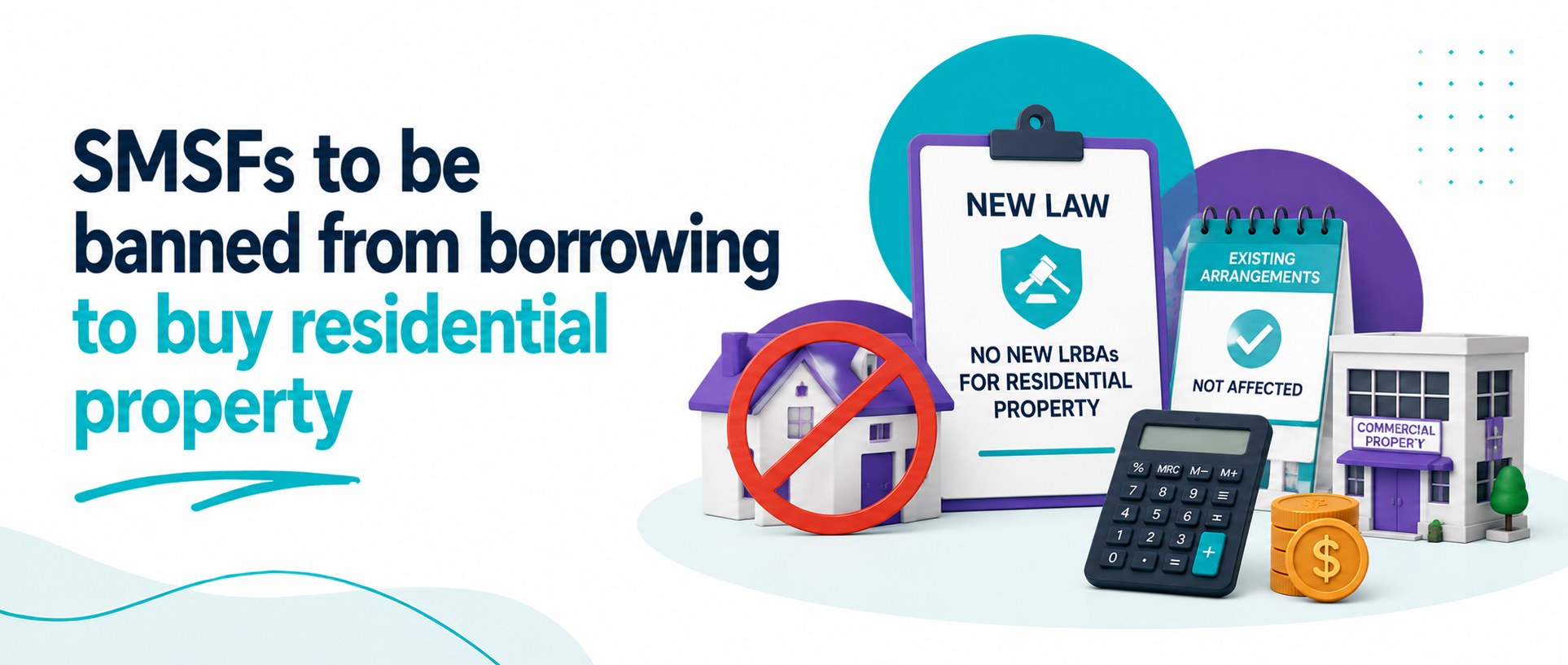
As part of the May Budget tax legislation that became law on 26 June 2026, the Government has banned new limited recourse borrowing arrangements (LRBAs) used by self-managed super funds (SMSFs) to purchase residential property.
What is an LRBA
Super funds are generally not allowed to borrow to invest. The one exception is the LRBA, which allows an SMSF to borrow money to purchase a single asset (typically property) held inside a separate bare trust. If the loan defaults, the lender can only claim that one asset and the rest of the fund’s assets are protected.
LRBAs have been used since 2007 and have become a common strategy for SMSF members to acquire residential and commercial property inside super.
What is changing
From the date the legislation takes effect, SMSFs will no longer be able to enter new LRBAs to purchase residential property. With Royal Assent received on 26 June 2026, the ban commences 45 days later, on 10 August 2026.
What is not changing
Key takeaway
If you already have an LRBA in your SMSF, nothing changes. If you have been planning to buy residential property through your SMSF, talk to your accountant and financial adviser as soon as possible to understand your options and the timing. Business owners considering acquiring their business premises through their SMSF can continue to use an LRBA, as commercial property is not affected by the ban.
What has become law from the May Budget
The first round of legislation from the May Budget became law on 26 June 2026. Here is what is in it and what it could mean for you.
Capital gains tax is changing from 1 July 2027
If you sell an asset such as an investment property, shares or your business, the way your capital gain is taxed is changing.
Right now, if you have held the asset for more than 12 months, you only pay tax on half of the gain. This is the 50% CGT discount that most investors and business owners are familiar with.
From 1 July 2027, that discount is being scrapped and replaced with two new rules:
The combined effect is that some taxpayers will end up paying more tax on capital gains than they do today, while others may pay less depending on how long they hold the asset and how much it grows above inflation.
An option for new residential properties
If you invest in an eligible new residential dwelling, you will have a choice. You can either stick with the existing 50% CGT discount or use the new indexation and 30% minimum tax arrangements, whichever gives you the better outcome. Investors in affordable housing will have a similar choice, with the existing CGT discount of up to 60% being fully retained.
What this means for assets you already own
If you already own assets, the changes apply prospectively from 1 July 2027. Any capital gain that accrued up to 30 June 2027 will still be eligible for the 50% CGT discount when you eventually sell. Only the gain that accrues from 1 July 2027 onwards will be subject to the new indexation and 30% minimum tax rules.
This split treatment means establishing a market value as at 30 June 2027 will be critical to working out how much of your gain is taxed under the old rules versus the new ones. This applies to all CGT assets, not just property. Shares, business assets, units in trusts and other investments are all caught.
The Government has indicated there will be two methods available to work out this value:
You will not need to decide which method to use until you actually sell the asset.
However, for many taxpayers the ATO apportionment tool may not produce a fair or appropriate result. It is likely to work reasonably well for assets with observable market prices, such as listed shares, but for property, businesses and other complex assets, a formula based on a growth rate is unlikely to reflect the real value of the asset at 30 June 2027.
This is where planning ahead matters. The Commissioner generally accepts valuations from a registered or qualified valuer. Real estate agent appraisals and rough estimates are not viewed as reliable evidence and are likely to be challenged.
For business owners, a proper business valuation will be far more useful down the track than back of the envelope figures or a formula that does not reflect what your business is actually worth. We offer business valuation services and can prepare one for you leading up to 30 June 2027.
Without proper valuation evidence, it will be difficult to substantiate how much of the gain accrued before 1 July 2027 and you could end up paying more tax than necessary.
What is not affected
Some important things remain unchanged:
Good news for small business owners selling their business
If you sell your business or a business asset, the small business CGT concessions can significantly reduce or even eliminate the tax on your capital gain. The most commonly used of these is the 50% active asset reduction, which reduces your taxable gain by half on top of other CGT relief.
Currently, you can only access this concession if your business has aggregated turnover of less than $2 million or if you meet the $6 million maximum net asset value test. However, many businesses miss out as they aren’t able to satisfy either test.
From 1 July 2027, the turnover threshold for the 50% active asset reduction is being lifted from $2 million to $10 million. According to the Government, this will mean around 2.7 million small businesses (around 98% of active businesses) will be eligible. The $6 million maximum net asset value test stays the same. Importantly, this change only applies to the 50% active asset reduction. The other small business CGT concessions (the 15-year exemption, retirement exemption and small business rollover) continue to use the existing $2 million turnover threshold or $6 million maximum net asset value test.
Personal tax relief for workers
From 1 July 2026, a $1,000 standard deduction for work-related expenses is being introduced. You can claim this without needing to keep receipts or itemise your expenses. If you have genuine work-related expenses above $1,000, you can still claim the higher amount in the usual way and provide the substantiation. This is intended to simplify tax time for most workers.
From 1 July 2027, a new Working Australians Tax Offset of $250 per year will apply. This is a permanent non-refundable offset for all Australian workers earning above the tax-free threshold.
Negative gearing changes for property investors
If you are considering a residential investment property, please note the proposed changes to negative gearing. These changes apply to residential properties where the contract was entered into after 7:30 PM (AEST) on 12 May 2026.
Key takeaway
These changes are now law. If you are considering selling a business, an investment property, or shares, the timing of that sale could materially change your tax outcome. The same applies if you are looking at buying a residential investment property. Speak to your accountant before you commit so you understand where you stand.
Get Cashed Up
Liability limited by a Scheme approved under Professional Standards Legislation.
Select your desired option below to share a direct link to this page.
Your friends or family will thank you later.